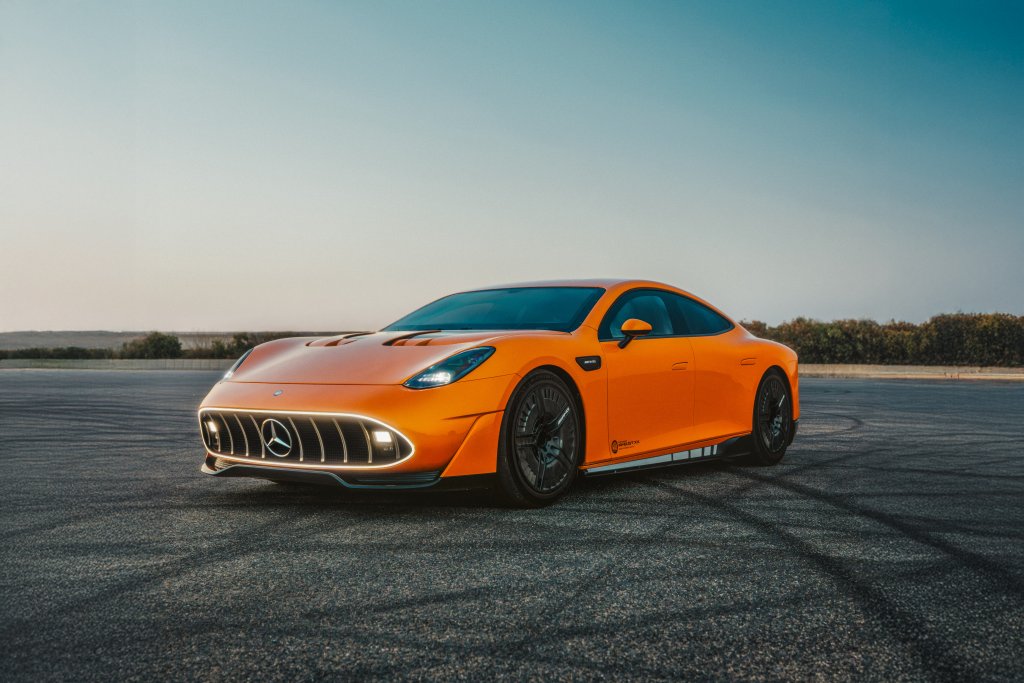
- High-performance cooling concept: Innovative Central Coolant Hub (CCH) and cooling plate in underbody
- Advanced aerodynamics: Precision airflow management for superior cooling and high-speed stability
- High charging capacity: Short charging times and charging power enabled by new charging station and High-Power Charging Hub
- Intelligent software: Record-breaking strategy powered by Formula 1® expertise
- Purpose-built display concept: UI/UX design for peak performance
- New innovations: AR racing helmet, plasma actuator, 3D body scan and ThrillAR
The CONCEPT AMG GT XX captured global attention when it covered 40,075 kilometers (24,901 miles) on the legendary Nardò test track in less than eight days – setting a total of 25 long-distance records with an impressive margin during this journey "around the world in eight days." Under extreme test conditions, the technology pioneer demonstrated its superior endurance, continuing Mercedes‑AMG’s long tradition of record-breaking achievements. The performance brand from Affalterbach pushed the limits with two vehicles sprinting lap after lap, breaking record after record, at a running speed of 300 km/h (186 mph) – for 7 days, 13 hours, 24 minutes and 07 seconds.
Among the records is the one for the longest distance ever covered by an electric vehicle in 24 hours. In this extreme endurance test, the previous benchmark wasn’t just broken once – it was shattered fourteen times. Mercedes-AMG fielded two CONCEPT AMG GT XX units in the Nardò challenge. Both vehicles exceeded the previous record in every single 24-hour window by an overwhelming margin.
This ultimate stress test was only possible thanks to the unmatched endurance capability of its revolutionary drivetrain. The CONCEPT AMG GT XX is powered by three axial flux motors and a direct-cooled battery – technologies that will enter production next year in the upcoming new high-performance AMG.EA architecture.
A host of additional, partially production-ready innovations also played a key role in this grueling test. Among these are an integrated cooling concept, sophisticated aerodynamics and an intelligent operating strategy.
Moreover, the CONCEPT AMG GT XX also introduces a range of innovations in both its exterior and interior. Highlights include an augmented reality racing helmet, ergonomic 3D seat pads and novel biotechnology-based materials. Exterior highlights include illuminated paint elements along the sides of the vehicle, headlights with integrated speakers and the MBUX Fluid Light Panel at the rear of the car.
“Mercedes‑AMG and Formula 1® stand for innovation, intense competition and pushing the boundaries of what is technically possible. Our powertrains have been delivering groundbreaking success since the very first road races in automotive history more than 120 years ago, setting benchmarks for decades. In the 1970s and 1980s, Mercedes‑Benz was a regular guest here at Nardò, setting numerous international speed and track records - most notably with the C111 as a visionary technology program. Back then, we demonstrated the performance capabilities of innovative diesel and gasoline powertrains. Now, with the CONCEPT AMG GT XX technology program, we are entering a new dimension of performance – this time with fully electric drive. The goal is to redefine the limits of what is technically possible in the age of electric drives. So what could be more fitting than to go chasing records once again? Our mission: to redefine the very standards of performance with groundbreaking technologies and innovations. The motivation and dedication of the cross-functional team from Mercedes‑AMG, Mercedes‑Benz, Mercedes‑Benz Mobility and our F1 engine experts at Mercedes‑AMG High Performance Powertrains throughout the entire preparation phase were boundless. I am immensely proud of the unprecedented achievement of the entire team in this unique record drive.”
Markus Schäfer, Member of the Board of Management of Mercedes‑Benz Group AG, Chief Technology Officer, Development & Procurement
“At AMG, innovation has a clear purpose: it must deliver performance for our customers. That’s why many of the technologies from the CONCEPT AMG GT XX will soon make their way into our production vehicles. At the heart of this is, of course, the revolutionary drive concept featuring axial flux motors and a directly cooled battery, both of which will be available as early as next year. In addition, we are leveraging the data gathered in Nardò to further refine our upcoming high-performance architecture, AMG.EA. Our customers will benefit from an entirely new dimension of sustained electric power.”
Michale Schiebe, CEO of Mercedes‑AMG GmbH and Head of Business Units Mercedes‑Benz G‑Class and Mercedes‑Maybach
Innovative cooling with Central Coolant Hub (CCH) and passive cooling plate in the underbody
Powerful cooling is essential to delivering the sustained power of the CONCEPT AMG GT XX. At its core is the innovative direct liquid cooling of the high-performance battery. However, the demand-based cooling of the Electric Drive Units (EDUs) on the front and rear axles and the OneBox – which integrates the power electronics for the 12-volt onboard system and the onboard charger – were also crucial.
Different systems require different temperature ranges. For example, the EDUs operate in a different temperature range than the battery. The Central Coolant Hub (CCH) precisely supplies all components. This highly integrated component is the "mastermind" of the cooling system in the CONCEPT AMG GT XX. It is located compactly between the front EDU and the left front longitudinal member of the chassis.
In the CONCEPT AMG GT XX, the Central Coolant Hub combines numerous sub-components in a single compact housing:
- High-performance cooling pumps
- Temperature sensors
- 4-way/5-way valves
Its integrated design requires fewer hoses, brackets, clamps and pumps than conventional solutions – saving both weight and space.
The CCH connects all components requiring cooling and also links to the main radiator and the two wheel arch radiators (one on each side at the front). Newly developed valves allow partial cooling circuits to be switched on or off as needed.
The Central Cooling Hub is designed for different scenarios. It can, for instance, deliver maximum cooling to all components during high-load driving and at elevated ambient temperatures, as was regularly required during the demanding endurance test in Nardò. However, targeted and efficient cooling of individual components is also possible.
The major advantage of this cooling system is its ability, in combination with the axial flux motors and directly cooled battery, to deliver full performance in virtually any situation – whether driving or charging. For example, after high-speed driving in hot conditions, the system allows immediate access to maximum charging power. Conversely, following a high-speed charging session, exceptional driving performance is instantly available. Unlike conventional EVs, which typically need to reduce output to reach optimal component temperatures (known as de-rating), the CONCEPT AMG GT XX delivers full power at all times.
Another integral element of the CONCEPT AMG GT XX’s cooling concept is the passive underbody cooling plate at the front. This development from Mercedes‑AMG High Performance Powertrains in England has already been tested in the VISION EQXX. The permanently flowed underbody cooling plate helps to relieve the main radiator so much that the air control system can remain closed over long periods. This improves energy efficiency and reduces aerodynamic drag.
Aerodynamics support cooling function
Aerodynamics also contribute to the high cooling performance. To achieve this, the AIRPANEL air control system – featured on the current AMG GT – was further developed. The system ensures an optimal balance between cooling and low drag, operating with movable louvers positioned behind the radiator grille. For the first time, the wheel arch coolers (including fans) are integrated into this system. In normal operation, the louvers remain closed, reducing drag and directing airflow purposefully towards the underbody. Only when additional cooling is required do the louvers open, providing the heat exchangers with cooling air on demand.
Aerodynamics: A Key Lever for High Performance, Especially at High Speeds
At 300 km/h (186 mph), approximately 83 percent of the drive energy is needed to overcome aerodynamic drag. Efficient aerodynamics are therefore particularly crucial in the high-performance segment, especially as the CONCEPT AMG GT XX completed the majority of its extreme endurance test in Nardò at precisely this speed.
Therefore, the vehicle is aerodynamically optimized for high speeds. Its athletic design is defined by a low-slung hood and sleek greenhouse. Complementing this are a low-slung front section with side air curtains, front splitters ahead of the wheels, and a long, wide rear with diffuser and side blades.
Numerous Individual Measures Delivering an Outstanding Drag Coefficient of 0.19
Through focused work on numerous details, the already excellent drag coefficient could be further improved. Individual measures such as optimized aero-mirrors, an extended diffuser and the rear spoiler lip have further improved the aerodynamics. Overall, the Cd value of the CONCEPT AMG GT XX during the extreme test in Nardò was only 0.19, despite wide high-performance tires.
This outstanding value had a direct impact on the long-distance test. At the speeds driven in Nardò, an improvement of just 1 point (Cd reduced by 0.001) has a similar effect on range and efficiency as a weight saving of approximately 90 kg (198 lbs).
A specifically developed underbody contour ensures an optimized aero-balance and thus the optimal contact pressure with maximum efficiency. It creates the Venturi effect, which reduces lift at the rear axle with minimal impact on drag, providing extremely high driving stability. The active rear spoiler could remain retracted during the extreme test because the CONCEPT AMG GT XX generates sufficient downforce through its sophisticated aerodynamics alone.
New 20-inch wheels with carbon-fiber elements
The wheels were also newly developed for the mission in Nardò. The 20-inch diameter offers the optimal balance between driving stability and low drag. The aero-carbon elements used in the aluminum wheels differ on the front and rear axles. On the front axle, the slats direct air from the outside to the inside of the wheel, while on the rear axle air is directed from the inside to the outside of the wheel. This improves air flow around the vehicle and increases driving stability with less drag than fully closed wheels.
Brake cooling was less of a demand because deceleration was almost entirely done via recuperation during the drive, up to the pit stop. The car was fitted with Michelin high-performance tires, which were developed to combine top performance with maximum efficiency.
High charging performance and short charging times thanks to newly developed charging station by Alpitronic
In addition to high speeds on track, high charging speeds were a key factor to success during the endurance test. The CONCEPT AMG GT XX charged at an average of approximately 850 kW in Nardò, thanks to a newly developed Alpitronic charging station and the temporary High-Power Charging Hub.
To achieve high charging performance and short charging times, the team installed its own High-Power Charging Hub at the test site, including medium-voltage power lines, transformers and charging stations. The project drew on the expertise of the Mercedes-Benz Charging Unit, responsible for building the global Mercedes-Benz High-Power Charging network. The construction of the temporary High-Power Charging Hub in Nardò was also completed in record time. From the building permit application to commissioning, it took just under three months. The new grid connection also offered exceptionally high performance. The hub was designed for three chargers with a total of over 2.5 megawatts.
To match the charging performance of the CONCEPT AMG GT XX, the Mercedes‑Benz Charging Unit worked closely with its partner Alpitronic, the European market leader in high-power charging. Alpitronic developed a special prototype charging station for the project. For the first time, this can transmit currents of up to 1,000 amps via a standard CCS cable – twice as much as previously possible. This was made possible in part by using an MCS dispenser originally designed for trucks. In this case, the MCS cable was replaced by a conventional CCS cable utilizing enhanced cooling capabilities. The charging system was developed jointly with the vehicle itself. On a test bench in Stuttgart‑Untertürkheim, the development team simulated real charging scenarios in which vehicle components and the charging station were tested and validated together. This demonstrates Mercedes-Benz's holistic development approach.
Intelligent software and record strategy with expertise from Formula 1®
Another important factor in the mission was the intelligent operating strategy, including the Battery Management System (BMS) based on the Mercedes‑Benz software architecture, MB.OS. Experts at Mercedes-AMG in Affalterbach and Mercedes-AMG High Performance Powertrains (HPP) in Brixworth further developed it to keep the battery within its optimal performance window at all times.
A key challenge was the internal processes of individual battery cells cannot be measured directly – yet these insights are vital for developing an optimal strategy. To overcome this, the team used specially modified cells and sensors in advance to learn how the cells behave during use. For this purpose, the battery cells were measured and tested in detail with special reference electrodes and core temperature sensors. The collected data fed directly into the BMS software, enabling precise cell modeling and, for example, further improving charging performance. The simulations created “virtual sensors” derived from the physical measurements. With these virtual sensors, the BMS software can simulate a real-time view into the core of the battery cells during the entire drive.
In numerous simulations, the optimal strategy for the extreme drive was developed in advance. This included determining the ideal driving speed of 300 km/h (186 mph), which offered the best balance of speed and efficiency. The condition of each individual cell could also be recorded in the simulations and regulated via the BMS. After the individual simulation cycles, the team validated the results at the cell level, then with real units on the e‑Drive test bench in Stuttgart‑Untertürkheim, and later also on the test track. With the knowledge gained, the next simulation could be optimized to enable even more accurate forecasts for the real drive.
In addition, simulation experts at Mercedes‑AMG High Performance Powertrains (HPP) developed a tool that could compare the pre-calculated operating strategy live with the conditions onsite. During the endurance test in Nardò, the HPP engineers monitored whether external factors such as temperature, wind, road debris or tire wear had an impact on the drive and vehicle components. Since the data was permanently transmitted to the Mission Control Truck, the experts were able to continuously adapt the strategy to the real driving situation – and, for example, flexibly extend or reduce the length of a stint.
In close collaboration with HPP, the development team of the CONCEPT AMG GT XX also calculated a driving profile for the individual stints. The basic principle is derived from Formula 1®. At the beginning, the vehicle accelerates to the target speed of 300 km/h (186 mph), which is maintained for a pre-calculated number of laps. When it is time for the next charging stop, the vehicle uses recuperation of up to 0.6 g to decelerate and feeds the energy back into the battery. This allows the CONCEPT AMG GT XX to enter the pit area at the optimal speed and stop exactly at the charging station. Following the rapid charge, it launches back to 300 km/h (186 mph), seamlessly resuming the cycle.
Predictive Performance Manager
The Predictive Performance Manager (PPM) also made a significant contribution to the success of the CONCEPT AMG GT XX. The specially developed powertrain software optimizes energy flow and gives the driver instructions for a particularly performance-efficient driving style, thus supporting the practical implementation of the strategy. This is done acoustically and visually with signals in the augmented reality helmet and in the instrument panel. For the precise driving instructions at certain points on the track, the PPM uses the GPS track data from AMG Track Pace, which are stored in the system.
Tailor-made display concept for the record drive
The new Mercedes‑Benz Operating System (MB.OS) is also the foundation for the specially designed display concept. The deeply integrated software-to-cloud architecture connects and controls all control units and functions. For the record run of the CONCEPT AMG GT XX, a customized UI/UX concept (UI = User Interface; UX = User Experience) was programed to support and relieve the drivers during the high-speed runs.
The 10.25-inch instrument cluster in front of the driver displays relevant vehicle data such as speed and battery charge level. A 14-inch multimedia display oriented towards the driver has a "seamless glass" appearance and displayed important vehicle parameters for the drivers during the record run.
In addition to the current driving time and the number of laps completed since the last charging stop, the display also showed the distance covered, the vehicle’s real-time position on the track, battery state of charge (SoC), status of the charging flap and the current driving mode. During charging, the multimedia display switched to a dedicated view in which the vehicle silhouette rotated to a side view, highlighting the battery with a pulsing light to draw attention to the rising state of charge.
The steering wheel also offered additional functionality. The two AMG DRIVE UNIT steering wheel buttons, familiar from AMG production models, were configured exclusively for the record run. The left button controlled the setting of the next recuperation point, while the right button allowed manual adjustment of the active louvers and selection of the number of laps before the next charging stop.
Similar to Formula 1® and the AMG ONE, the upper rim of the steering wheel featured eight LEDs providing further information. Depending on the number of LEDs illuminated, these indicated the progress of certain functions. During the charging stop, the LEDs are blue until the desired state of charge is reached. Green LEDs are the signal to start driving, red lights indicate that the driver must wait. During driving, white LEDs prompted drivers to “lift and coast,” while blue lights indicated recuperation.
Racing helmet with augmented reality functions
Mercedes‑Benz has been a pioneer in the use of Augmented Reality (AR) in vehicles for years. In the CONCEPT AMG GT XX, the technology is integrated directly into a racing helmet for the first time. The augmented reality racing helmet is therefore an additional, innovative component of the user experience.
The helmet provides vehicle and track information into the driver’s field of view in real time, depending on the situation. This allows the driver to keep their eyes on the track. The displays supplement the information on the screens in the vehicle. The data show includes battery charge level, speed, lap counter and the function selected via the steering wheel buttons. Speed-dependent colored lane indications in the form of arrows are also displayed, which have proven valuable, especially during night driving. The start and end of recuperation phases were represented by augmented reality gates. The current position of the vehicle on the high-speed track was also displayed.
The helmet is designed to match the record-breaking vehicle, painted in Sunset Beam Orange and bears the AMG emblem on the back. It also equipped with the HANS (Head And Neck Support) safety system. Weighing approximately 2 kg (4.5 lbs), it is very light despite the AR equipment and battery required for it. The development partner is Aegis Rider Helmets, a start-up from ETH Zurich. The test drivers Manuel Metzger, Thomas Jäger and Fabian Vettel also contributed their expertise from GT3 racing.
Active aerodynamic control of air flow with plasma actuators enables new design freedom
As part of the CONCEPT AMG GT XX technology program, research was also conducted into a fundamentally new technology, even though it was not directly related to the drive in Nardò or a soon-to-be series production "Aerodynamics by wire."
For the first time, the research team was able to use an electric plasma actuator to create a targeted flow separation on a body curve at the rear. Normally, this requires a physical, geometric spoiler lip on the outside of the vehicle. This highly innovative solution reduces drag, improves aero performance and enables completely new design freedom.
The proof of effectiveness could now be provided for the first time on a 1:1 wind tunnel model of the CONCEPT AMG GT XX. Successful measurements were carried out in the wind tunnel at speeds of up to 200 km/h (124 mph). Mercedes‑Benz is thus the world's first automobile manufacturer to have successfully tested this innovative technology in such a setting and will now continue research on the plasma actuator to examine future application in vehicles.
The plasma actuator consists of two asymmetrically arranged electrodes, which are separated by an insulating dielectric layer and can be attached flush to various components. Applying a high-frequency alternating voltage between the electrodes leads to the formation of an electric field and weakly ionized air (= plasma). The ions are accelerated by the electric field, and the particle-particle collision leads to a momentum transfer from the ions to the surrounding neutral air. This momentum transfer is commonly referred to as plasma actuator volume force. This induces a flow locally, making the actuators suitable for use in flow control.
The components of the plasma actuator are thin and light. These can be painted, making them no longer visible in the overall appearance. Due to the design, the components can contribute to improving the drag coefficient and energy efficiency of the vehicle. Plasma actuators also do not require any mechanical, hydraulic or moving parts. These can be adapted very quickly to different design concepts and can be easily built in different sizes and shapes.
Seats: innovative, tailormade 3D printed ergonomics
The front bucket seats are based on carbon racing shells with ventilation openings and integrated head restraints. The ergonomically optimized seat pads with an open 3D structure are new. These can be easily replaced using hook-and-loop type fasteners. This creates a comfortable seat structure adapted to the respective driver. The seat pads are covered with LABFIBER Biotech Leather Alternative in Pearl Black.
The idea behind the seat pads also comes from motorsport. There are individual seat cushions for each driver that can be quickly replaced – for example, for changing drivers in endurance races. In the CONCEPT AMG GT XX, the individually shaped seat pads were created using a 3D printing process. The ergonomics-relevant data is provided by a body scan of each driver. If several drivers are sharing the cockpit, the right pad is simply inserted as needed – quickly, precisely and with optimal ergonomics for each individual.
ThrillAR Experience: reliving the record-breaking drive
With the "ThrillAR" Experience, the CONCEPT AMG GT XX innovation team staged the high-speed lap of Nardò exclusively for media representatives as a captivating mixed-reality adventure using the Apple Vision Pro. In this special XR experience, track data, lap times and vehicle performance merged with elements like an interactive pit stop. The highlight was a virtual drive in which users could get behind the wheel of the CONCEPT AMG GT XX and experience the last miles to the finish line. The versatile format will also be used at the upcoming IAA Mobility and other future events, allowing a wider audience to experience the record-breaking drive at any time.
Michelin: tire innovation at the stress-test center alongside Mercedes‑AMG
For more than three decades, Michelin has supported Mercedes‑AMG in its most ambitious projects. To enable the CONCEPT AMG GT XX to cover more than 40,000 km (>24,855 mi) at a speed of 300 km/h (186 mph), Michelin developed a completely new tire: the MICHELIN Pilot Sport 5 Energy.
This high-performance tire is the result of five years of research and development. It heralds a series-product line that will be launched under the same name as early as next year. For its design, Michelin used state-of-the-art technologies to simulate vehicle and tire dynamics as well as multi-component 3D manufacturing processes.
The MICHELIN Pilot Sport 5 Energy features an innovative KM architecture with a two-component compound and differentiated characteristics. On the outer shoulder areas of the tread, the latest generation of the Energy Passive Compound helps to reduce energy consumption. In the middle, the new Adaptive Grip Compound maximizes traction on both dry and wet roads. This unique design offers exceptional energy efficiency and reduces charging frequency. The tire’s consistent performance also guarantees the driver the highest safety right down to the last mile.
To support the mission in Nardò, Michelin provided a team of engineers, technicians and fitters on site. They handled tire changes, provided technical support and ensured 24/7 monitoring of the tires using RFID chips.
Support from Microsoft for the CONCEPT AMG GT XX endurance test
Microsoft supported the endurance test of the CONCEPT AMG GT XX with technological infrastructure and a specialist Microsoft Mission Critical Team. The software company thus guaranteed seamless platform operation. During the mission, all data on the vehicle's condition was continuously collected and analyzed using a solution called MB.log developed by Mercedes‑Benz in collaboration with Microsoft. It operates in the Mercedes‑Benz Intelligent Cloud, which is provided on Microsoft's global cloud platform Azure, among others. In short, MB.log in combination with the onboard measurement hardware is the vehicle's data nervous system. It captures, transmits and analyzes performance-critical data, enabling engineers to monitor and optimize vehicle settings under extreme conditions.
Signify enabled performance and safety during the mission in Nardò
To support the CONCEPT AMG GT XX endurance test, the team strategically deployed intelligent, energy-efficient Signify lighting at critical points along the track, including the tunnel section and pit stop area.
In the tunnel, Signify's Philips Ledinaire floodlights combined with Color Kinetics ColorGraze IntelliHue luminaires provided balanced, functional lighting. The powerful ColorGraze luminaire highlights architectural features. Thanks to IntelliHue technology, it can produce millions of saturated colors, pastels and high-quality white light in precisely controllable, uniform luminosity. Strategically positioned outside and inside the tunnel, the light guides drivers precisely around the track. The Ledinaire floodlights provide a high light output and thus an excellent view of the car for the pit stop crew. This supports quick tire changes and minor repairs.
One section of the off-grid track required special attention due to the high level of movements by drivers and pedestrians. When cars are passing at high speeds, it is important to provide additional safety with lighting. The Philips SunStay Pro solar lights installed here provided uniform illumination and minimized environmental impact thanks to the circular design – a clear commitment to clean energy and resource-sensitive lighting solutions. Together, these technologies not only lit up the track, but also shaped the driving experience and supported Mercedes‑AMG in every step of its mission.
# # #
About Mercedes-Benz USA
Mercedes-Benz USA (MBUSA), headquartered in Atlanta, is responsible for the distribution, marketing and customer service for all Mercedes-Benz products in the United States. MBUSA offers drivers the most diverse lineup in the luxury segment with 18 model lines ranging from the sporty GLA SUV to the flagship S-Class and the dynamic all-electric vehicles from Mercedes-Benz. MBUSA is also responsible for Mercedes-Benz Vans in the U.S. More information on MBUSA and its products can be found at www.mbusa.com and www.mbvans.com.
Michelin
Michelin aims to sustainably improve the mobility of its customers and to become one of the world's leading manufacturers of composite materials. As a pioneer in the development of technical materials and with more than 130 years of experience, the Michelin Group is in an excellent position to make a decisive contribution to progress and a more sustainable world. Based on its expertise in polymer composites, Michelin develops innovations for high-quality tyres and components in various application areas such as mobility, construction, aeronautics, low-emission energies or healthcare. With other offers, Michelin enables its customers to enjoy unique travel experiences. Headquartered in Clermont-Ferrand, France, the company employs 129,800 people worldwide, 6,000 of whom work in research and development. Michelin operates 86 plants for tyre manufacturing and 45 production facilities for high-tech materials.
Alpitronic
Alpitronic was founded in 2009 and is headquartered in Bolzano (South Tyrol/Italy). Today, the company develops and manufactures high-performance charging solutions in the field of electric mobility. With a consistent focus on innovation, reliability and quality, Alpitronic has become the leading provider of scalable DC fast-charging infrastructure in Europe – and continues to grow through a targeted internationalisation strategy and strong partnerships. The Hypercharger product family – including the established HYC200 and HYC400 systems as well as the newly launched distributed megawatt charging system HYC1000 – offers a future-proof platform designed to meet the ever-growing demands of modern electric vehicles – from passenger cars to heavy-duty commercial vehicles in long-haul transport.
Signify
Signify (Euronext: LIGHT) is the world's leading provider of lighting for professionals, consumers and the Internet of Things. Our Philips products, interact systems and data-driven services add value and transform lives in homes, buildings and public spaces. In 2024, we generated sales of 6.1 billion euros, employed around 29,000 people and were represented in over 70 countries. We unlock the extraordinary potential of light for a brighter life and a better world. Since our IPO, we have been included in the Dow Jones Sustainability World Index for eight consecutive years and have achieved the EcoVadis Platinum rating for five consecutive years. This makes Signify one of the top one percent of the companies evaluated. You can find news from Signify in the newsroom, on X, LinkedIn and Instagram.