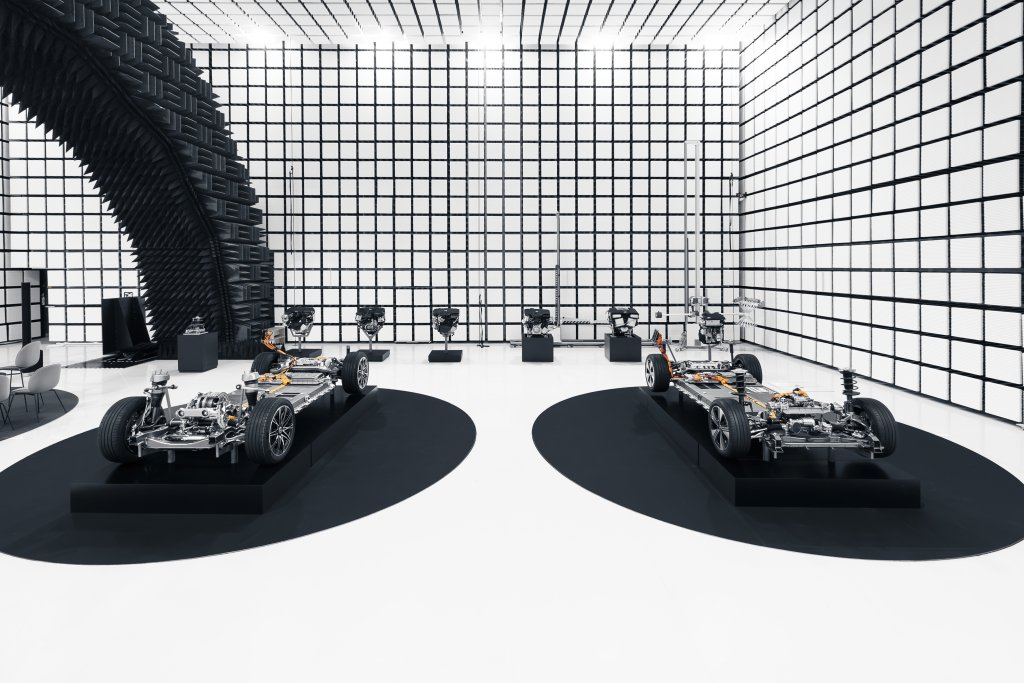
- For 140 years, Mercedes-Benz has understood what drives its customers: this knowledge is continuously incorporated into the development of its powertrain technologies
- Connected vehicles provide insights from billions of anonymized real-world driving kilometers, helping Mercedes-Benz understand how customers actually use their cars, informing powertrain development tailored to those needs – simulated and validated on the test bench long before they reach the road
- Whether fully electric or with a high-tech electrified combustion engine, Mercedes-Benz applies intelligent modularity to scale powertrains, batteries and software across model ranges
- Mercedes-Benz is further strengthening its battery expertise by developing its own cell chemistry and researching solid-state batteries for even more powerful powertrains that are better suited to everyday use
- Technology transfer from Formula 1 accelerates innovation across all types of drive and strengthens Mercedes- Benz’s development expertise – the latest example being the new electric turbocharger in the most powerful four-cylinder engine within the compact segment
Stuttgart. Nearly 30 new model launches by 2028: what was almost unimaginable a decade ago will become a reality at Mercedes-Benz by the end of 2027. The brand is expanding its portfolio faster and more significantly than ever before. Whether fully electric, plug-in hybrid or high-tech electrified combustion engine, Mercedes-Benz offers the right powertrain for every customer’s needs worldwide. This is underpinned by data-driven development, digital simulations, intensive test bench work and more than 140 years of engineering expertise. Thanks to intelligent modularity, powertrain systems, batteries, vehicle architectures and software can be flexibly scaled across numerous models – thereby offering technological diversity. The Mercedes-Benz Operating System (MB.OS) integrates the key vehicle functions into a single intelligent adaptable and updateable system, regardless of powertrain. This creates the brand’s signature driving character in every vehicle: the perfect blend of comfort, safety, composure, sportiness and precision.
“No technology shapes the character of a vehicle as much as the powertrain, whether fully electric or hybrid. Our customers around the world have different needs and expectations. That is why we are committed to utilizing the best technology in such a way that it delivers tangible added value and inspires our customers. True innovation arises where technical excellence translates into an intuitive driving experience and creates an almost instinctive emotional connection between the driver and the vehicle.”
Jörg Bartels, Vice President, Powertrain Development, Mercedes-Benz AG
From digital simulation to physical testing: powertrain development tailored to customer needs
Mercedes-Benz continuously develops powertrains based on real customer needs and usage scenarios. The focus is not on a one-size-fits-all solution, but on finding the right powertrain for different requirements. Every powertrain must deliver both dynamic performance and everyday comfort. For example, someone who drives dynamically on the motorway still expects confident comfort around town.
The development of any powertrain system begins with a detailed understanding of actual customer behavior. Driving cycles, acceleration patterns, accelerator pedal movements, towing and hill starts are translated into specific development objectives. This initially results in the appropriate powertrain concept being developed through computer simulation: power, torque, gear ratios and control strategies are virtually tested in countless combinations before a single component is produced. This simulated behavior is then measured and validated on the test bench under real-world load and temperature conditions – for example, how torque builds up or how power changes at high temperatures. Only then does testing in the vehicle take place. This ensures that a Mercedes-Benz performs at its best under all conditions.
Perfectly tailored to each vehicle and its powertrain, the suspension, brakes and steering are developed as one integrated system. The result is the unmistakable Mercedes-Benz driving character: a unique combination of comfort, sense of safety, composure, sportiness and precision that runs throughout the entire portfolio. Regardless of powertrain, every Mercedes-Benz delivers a familiar driving experience, supports the driver in critical situations and enables relaxed travel on both long and short journeys.
Fully electric or with an electrified combustion engine: modular powertrains, scalable across segments
All powertrains from Mercedes-Benz are based on a modular principle with a high degree of component commonality. This enables technological diversity, accelerates further development and supports cost-effective development and production.
When it comes to combustion engines, Mercedes-Benz applies modular design and high scalability. The electrified, high-tech petrol engines in the FAME range (Family of Modular Engines) combine low fuel consumption enabled by ISG 2.0 with increased power for a wide range of vehicles – from the GLA to the S-Class. Common features include an all-aluminum crankcase with NANOSLIDE® technology, a cylinder head with a partially integrated manifold, a turbocharger with a segmented turbine and switchable bypass connection, a compact intercooler system and the exhaust system located close to the engine. A standardized MB.OS architecture creates synergies in the powertrain software.
For fully electric models, Mercedes-Benz has also developed a modular powertrain architecture derived from the groundbreaking VISION EQXX technology program. This can be scaled across all model ranges and segments. In the CLA, GLB and GLA, as well as the GLC and C-Class, it combines outstanding suitability for everyday use and long-distance travel with the driving experience typical of Mercedes – tailored in each case to the different customer needs and usage profiles. As a next step, Mercedes-Benz is scaling up this 800-volt architecture for larger model ranges, including the E-Class and S-Class.
Customers experience the interplay of all the components. In a fully electric powertrain, the high-voltage battery, electric drive unit (EDU), thermal management, charging system and software all work together as a single system. The aim is to minimize energy losses from cell to wheel.
Electric drive unit: developed and manufactured by Mercedes-Benz
The electric drive unit 2.0 (EDU) is one of two key components of the all-electric powertrain. Because of its importance, Mercedes-Benz developed it entirely in-house and manufactures it within its own powertrain production network. The EDU 2.0 is further proof of Mercedes-Benz engineering expertise and manufacturing precision.
The electric drive system was designed from the outset to operate at 800 volts. It harnesses the benefits of the high-voltage system from the air-conditioning compressor right through to the drive – a first in the entry-level segment. Silicon carbide in the inverter further boosts efficiency. The EDU 2.0 combines a two-speed gearbox with a dog clutch, thereby resolving the trade-off between maximum torque, top speed and energy consumption. This applies in real-world driving conditions as well, not just on the test cycle. Thanks to its compact design, it also creates space for the rear cabin layout.
Development of new cell chemistry platforms with Mercedes-Benz DNA
The battery is the second key technology in electric mobility and a core strategic competence for Mercedes-Benz. Different vehicle segments and customer requirements require different cell technologies that are specifically designed for range, charging power or performance. Mercedes-Benz defines the requirements, develops the battery systems and integrates them precisely into the vehicles.
At the same time, the company is working on next-generation battery cells. The aim is to achieve higher energy densities, shorter charging times and more performance with lower raw material consumption and lower costs.
An important development step is the combination of lithium manganese oxide (LMO) and nickel manganese cobalt oxide (NMC). This cathode-material combination uses a higher proportion of manganese and less cobalt and nickel, enabling an attractive balance between energy density and cost. At the same time, this chemical combination forms the technological bridge to the manganese-rich cathode materials of the future. With lithium nickel manganese oxide (LNMO), Mercedes-Benz is advancing another promising cell chemistry. It would eliminate the need for cobalt, require significantly less nickel than today’s NMC cells and offer the potential to combine high energy density with attractive costs. The key would be the high-voltage capability of LNMO-based cell chemistry, which could operate at voltages of up to five volts. Compared with LFP, range advantages of up to 30 percent could be possible at comparable weight and packaging space.
Mercedes-Benz aims to develop even more compact and lighter battery systems, while maintaining the same or even higher performance. These systems open up new possibilities for vehicle design and interior layout. Furthermore, manganese-based cell technologies can reduce reliance on critical raw materials. Developing in-house cell chemistry platforms increases flexibility in responding to technological developments, market changes and regulatory requirements.
Tangible progress in the development of solid-state batteries
Mercedes-Benz is driving forward the development of solid-state batteries in collaboration with its strategic partners, Factorial Energy and ProLogium. With Factorial Energy, a lithium-metal solid-state battery has already been developed and tested for the first time under real-world driving conditions in an EQS. The development vehicle covered 1,205 kilometers from Stuttgart to Malmö without recharging, thereby demonstrating the technology’s potential for long ranges.
Mercedes-Benz is investigating the next generation of solid-state cells with several partners, including ProLogium’s next-generation cells. The focus is on extensive testing of Gen4 cell technology in terms of performance, safety and thermal properties. The aim is to assess their potential for future series production. In addition, tests are being carried out with solid-state cells from other partners and those developed in-house, incorporating motorsports know-how from the Formula 1 powertrain experts in the UK.
From the racetrack to the road: technology transfer from Formula 1
Powertrain development focuses on the continuous improvement of efficiency and performance. To this end, Mercedes-Benz works closely with Mercedes-AMG High Performance Powertrains (HPP) in Brixworth, England. This wholly owned subsidiary of Mercedes-Benz Group AG develops and manufactures Formula 1 powertrains
for the Mercedes-AMG PETRONAS F1 Team and various customer teams. The focus of the collaboration is not on the supply of individual components, but on the mutual exchange of expertise, development methods and the rapid pace of development in motorsport. The new electric turbocharger is one example of the close collaboration between Formula 1 and series development.
New electric turbocharger: visible proof of successful technology transfer
Mercedes-Benz has further developed the electrified 1.5-liter M 252 gasoline engine introduced last year. The new M 252 LS has an output of 228 hp + 30 hp, making it the most powerful four-cylinder engine in the Mercedes-Benz compact class. At the same time, it is the first engine from Mercedes-Benz with an electric exhaust gas turbocharger with an output of 7 hp. This is powered by the 48-volt onboard electrical system. The innovative system is derived from the technology that the Mercedes-AMG PETRONAS F1 Team has successfully developed and used over many years, contributing to eight Formula 1 World Championship titles.
This new form of turbocharging ensures particularly responsive performance over the entire rev range. This results in an even more dynamic driving experience, while simultaneously reducing fuel consumption. The M 252 LS is expected to reduce CO₂ emissions in the compact segment by up to 17% compared with the previous-generation M 260. In addition, the 7 hp electric turbo can recover energy and convert energy from the exhaust system into electrical energy. Two newly added Lanchester balance shafts reduce vibrations and ensure exceptionally smooth running.
# # #
Mercedes-Benz anniversary year “140 Years of Innovation”
Since Carl Benz filed the patent for the first automobile 140 years ago and Gottlieb Daimler built his motorized carriage shortly afterwards, Mercedes-Benz has dedicated itself to constant innovation and to creating the world’s most desirable cars for customers. This ambition has driven every innovation – from the world's first automobile in 1886 to the biggest product launch program in the company’s history that is currently underway. With its passion for performance and pioneering power, excellence and an unwavering commitment to customer service, the brand has consistently shaped the future of mobility. The result goes well beyond engineering achievement – it creates the unmistakable feeling that leads through everything Mercedes-Benz does: Welcome home.
Mercedes-Benz is celebrating 140 years of innovation by driving three new S-Class sedans on a transcontinental journey to 140 locations worldwide. Each place highlights the brand’s technology, heritage, pioneering spirit and worldwide presence. Along the way, customers, fans and colleagues will get to join in the celebrations – on an epic adventure that will run until October 2026. Follow the “140 Years. 140 Places” drive across six continents on our “140 Years of Innovation | Mercedes-Benz Media ” special and via the Mercedes-Benz Community.
About Mercedes-Benz USA
Mercedes-Benz USA (MBUSA), headquartered in Atlanta, is responsible for the distribution, marketing and customer service for all Mercedes-Benz products in the United States. MBUSA offers drivers the most diverse lineup in the luxury segment with 18 model lines ranging from the sporty GLA SUV to the flagship S-Class and the dynamic all-electric vehicles from Mercedes-Benz. MBUSA is also responsible for Mercedes-Benz Vans in the U.S. More information on MBUSA and its products can be found at www.mbusa.com and www.mbvans.com. To learn more about all Mercedes-Benz entities in North America, visit group.mercedes-benz.com/northamerica.