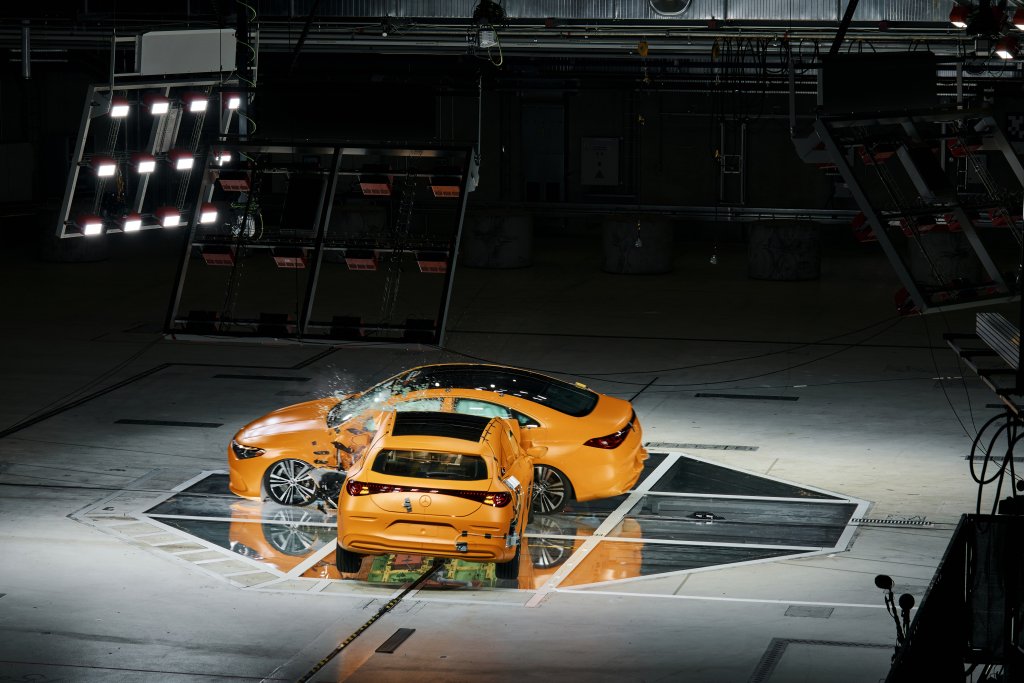
World’s first public high-speed side-impact crash test involving two CLA Sedans demonstrates occupant and battery protection
- The CLA’s driver assistance systems are designed to help prevent this type of collision or reduce its severity in everyday driving situations
- In the crash test, a CLA with an electrified internal combustion engine collided with the driver’s side of an all-electric CLA – both vehicles were traveling at 35 mph
- The scenario, which was deliberately designed to be particularly challenging, combined an unchecked side-impact collision, two vehicles each weighing more than 4,000 lbs and a speed of 35 mph
- Both vehicles offered outstanding occupant protection; the high-voltage battery in the all-electric CLA remained undamaged
Stuttgart. Mercedes-Benz has shown the world's first live high-speed side crash test with two production vehicles. Both vehicles were traveling at 35 mph – an exceptionally demanding practical test for the safety of the new CLA. In everyday driving situations, the CLA's modern driver assistance systems are designed to help drivers avoid such a collision or reduce its severity. To test the two vehicles, each weighing more than 4,000 lbs, Mercedes-Benz conducted the crash test – as is customary for such tests – without prior braking. A CLA with an electrified internal combustion engine drove directly into the driver's side of an all-electric CLA.
This is a high-speed and extremely severe side-impact collision. According to our group’s own accident research, a speed of 35 mph for both vehicles is at the upper end of these types of collisions in real-world driving situations. As there is considerably less space available on the side of the vehicle for energy absorption than at the front, this type of crash test scenario is considered one of the most critical for occupants and the vehicle structure. The chosen scenario is also particularly challenging, as the all-electric CLA is struck in the side by the other vehicle. These are precisely the areas that require the highest level of protection: the passenger compartment and, in the case of all-electric vehicles, the high-voltage battery housed in the underbody.
The result: Both CLA models demonstrated a high level of safety
The passenger compartments of both vehicles remained intact. The readings from all eight crash-test dummies, representing four adults and four children, remained below the relevant biomechanical limits. These limits are used within the industry to assess occupant protection. And the dummy readings indicate that all safety systems worked as intended to keep the occupants as safe as possible. The data, comprising up to 150 measurement points per dummy, confirmed the effectiveness of the vehicles’ safety systems. The results indicate a low risk of serious or life-threatening injuries to occupants. Also, the high-voltage battery remained intact and undamaged, despite the direct and severe side impact.
“Mercedes-Benz’s ambition is to build the safest vehicles in the world. That is why we develop safety systems that address real-world traffic scenarios. The world's first public intersection crash test conducted in this configuration is a powerful demonstration of that ambition.”
Why this test goes beyond the standards
No law and no safety rating requires a side-impact crash test involving two production vehicles. Standard tests are carried out against stationary barriers or so-called impact vehicles under specified conditions. However, Mercedes-Benz opted for two moving production vehicles and a scenario based on real-world accident data. The test speed of 35 mph represents the upper end of the real-world range for serious junction collisions. And: Around a quarter of accidents resulting in personal injury are side-impact collisions. The test therefore demonstrates how the holistic safety concept performs in an unusually severe real-life accident scenario.
“If you want to build the safest vehicles, you need to incorporate insights from real-world accidents into your vehicle development requirements. We call this Real-Life Safety. This test involving two CLA models demonstrates how we successfully translate that approach into reality.”
Prof. Dr Paul Dick, Director of Vehicle Safety, Mercedes-Benz AG
Safety, developed from real-life scenarios
Mercedes-Benz has been investigating and reconstructing real-life accidents since 1969. Approximately 6,000 accidents were analyzed – jointly by research teams in Germany, China and India. The findings are incorporated into vehicle body structures, restraint systems and the company’s own requirements.
Long before a new Mercedes-Benz vehicle is subjected to a physical crash test, it has already completed extensive virtual testing. During the development process, every new model undergoes around 15,000 crash simulations. Artificial intelligence supports our engineers in making these predictions even more precise. Overall, Mercedes-Benz carries out approximately 150 physical crash tests for a new model, going well beyond industry requirements in pursuit of high safety standards.
# # #