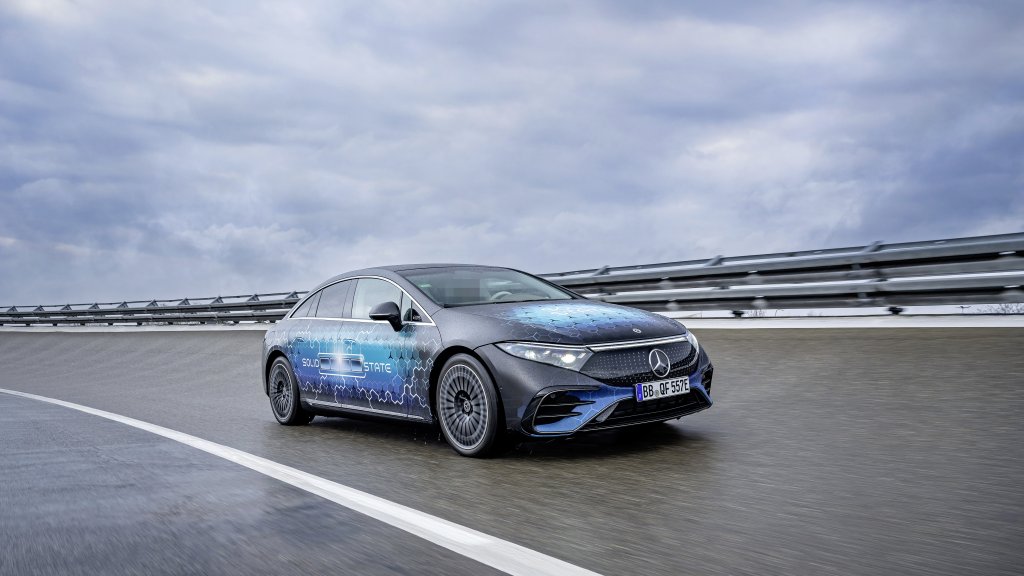
- Safer, lighter, more efficient and 25 percent longer range in the first vehicle: solid-state cell chemistry delivers higher energy density and weight reduction, with improved driving efficiency and cell safety
- Mercedes-Benz, together with Mercedes AMG High Performance Powertrains (HPP) based in Brixworth UK, developed and patented new innovative solid-state battery pack
- Mercedes-Benz integrated solid-state battery, with cells from U.S.-based solid-state battery leader Factorial Energy, into slightly modified EQS Sedan
- Road tests with new solid-state battery in "621 mile" EQS development car started in February 2025
Mercedes-Benz engineers from the road and racetrack worked in collaboration with Factorial cell engineers to deliver an all-new solid-state battery test program, resulting in the first car powered by a lithium-metal solid-state battery on the road. Mercedes AMG High Performance Powertrains (HPP), a wholly owned subsidiary of Mercedes-Benz Group specializing in industry-leading Formula 1 technologies, and the Mercedes-Benz Center of Competence for Battery Systems designed and developed a completely new innovative battery system. In addition to its prowess on the racetrack, HPP is capable of rapidly transferring F1 technologies and expertise into high performance automotive projects.
After intensive testing on various test benches, the prototype solid-state battery was integrated into a Mercedes-Benz EQS Sedan at the end of 2024. The vehicle was slightly modified to fit the solid-state battery and equipped with all accessories to operate it. The first laboratory vehicle tests were conducted in Stuttgart at the end of 2024 to prepare for the road tests that started in February 2025.
"Developing an automotive-scale solid-state battery underlines our commitment to innovation and sustainability. We're therefore excited to announce that we've started road testing with a prototype vehicle equipped with this advanced technology. We will gain crucial insights into possible series integration of this cutting-edge battery technology."
Markus Schäfer, Member of the Board of Management of Mercedes‑Benz Group AG. Chief Technology Officer, Development & Procurement
Solid-state batteries are a promising technology in electric mobility. The use of a solid electrolyte instead of liquid enhances cell safety and allows for the use of new anodes like lithium-metal, significantly outperforming conventional lithium-ion cells and enabling next-level energy densities. The solid-state technology reduces battery weight and has the potential to increase the gravimetric energy density for vehicle batteries up to 450 Wh/kg at the cell level, thereby increasing electric range. Gravimetric energy density refers to the amount of energy stored in a battery cell per unit mass and is crucial for evaluating the efficiency and performance of battery cells, especially in applications like electric vehicles where weight is a critical factor.
"Being the first to successfully integrate lithium-metal solid-state batteries into a production vehicle platform marks a historic achievement in electric mobility. This breakthrough demonstrates that solid-state battery technology has moved beyond the laboratory and into real-world application, setting a new benchmark for the entire automotive industry. Our collaboration with Mercedes-Benz proves that the future of electric vehicles is not just a vision, but a reality we're delivering today."
Siyu Huang, CEO and Co-Founder of Factorial Energy
Together with the motorsport experts from HPP, the Mercedes-Benz Center of Competence for Battery Systems developed a prototype solid-state battery with cells from Factorial that can be integrated into a car for road testing. The solid-state battery from Mercedes-Benz features an innovative floating cell carrier, for which a patent has already been granted. When the battery charges, the materials expand, and when it discharges, it contracts. The volume change in solid-state cells refers to the expansion and contraction of the materials inside the battery during charging and discharging. To support the cells during these volume changes, the Mercedes-Benz solid-state battery is equipped with pneumatic actuators that interact with the cell volume change during charging and discharging, which affects the battery's performance and lifespan.
The solid-state battery in the EQS-based test vehicle allows for up to 25 percent more electric range compared to the same battery weight and size of a corresponding standard EQS battery. Additional weight and energy efficiency is achieved through passive battery cooling. The development vehicle is expected to have a range of over 621 miles.
Over the next few months, Mercedes-Benz will continue its evaluation of the solid-state battery with extensive laboratory and road tests, noting its overall performance in an electric vehicle.
Mercedes-Benz joined forces with Factorial in 2021 to develop a new generation of battery technology. In the summer of 2024, Factorial delivered lithium-metal solid-state battery cells with the company's proprietary FEST® (Factorial Electrolyte System Technology) solid-state platforms to Mercedes Benz, which marked the first lithium-metal solid-state battery B sample shipment to a global OEM.
# # #
About Mercedes AMG High Performance Powertrain Ltd.
Mercedes AMG High Performance Powertrains is based in Brixworth, Northamptonshire. Its highly talented and ambitious team of over 1,000 people is responsible for the design, manufacture, testing and racing of Formula 1 power units enjoying enormous success with its partner team Mercedes-AMG F1 and Customer Teams. Additionally, its pioneering Advanced Technologies Team transfers F1 technologies and know-how into high performance automotive projects and products such as the Mercedes-AMG ONE and the Mercedes-Benz Vision EQXX. The roots of its business stretch back to 1984 and the foundation of Ilmor Engineering. Since 1995 the team based in Brixworth Northamptonshire has been responsible for the design and development of every single Formula One engine to wear the Mercedes-Benz badge. Renamed Mercedes-Ilmor Ltd in 2002, it became a wholly owned subsidiary of Mercedes-Benz Group AG in 2005 (at that time Daimler AG), operating under the name of Mercedes-Benz High Performance Engines – later switching to High Performance Powertrains.
About Factorial Inc.
Founded and headquartered in the United States, Factorial is at the cutting edge of solid-state battery technology, developing solutions that offer longer range per charge, increased safety and cost competitiveness with conventional lithium-ion batteries. The company's proprietary solid-state platforms FEST® (Factorial Electrolyte System Technology) and Solstice™ utilize electrolyte innovations that enable safe and reliable cell performance with high-capacity cathode and anode materials. Factorial's FEST® solid-state batteries are designed to integrate seamlessly with existing manufacturing processes, ensuring scalability and efficiency. The company has established joint development agreements with leading global automakers, including Mercedes-Benz. For more information, visit www.factorialenergy.com.
About Mercedes-Benz USA
Mercedes-Benz USA (MBUSA), headquartered in Atlanta, is responsible for the distribution, marketing and
customer service for all Mercedes-Benz products in the United States. MBUSA offers drivers the most diverse
lineup in the luxury segment with 18 model lines ranging from the sporty GLA SUV to the flagship S-Class and
the dynamic all-electric vehicles from Mercedes-Benz. MBUSA is also responsible for Mercedes-Benz Vans in
the U.S. More information on MBUSA and its products can be found at www.mbusa.com and www.mbvans.com.